


A group of second-year Physical Engineering students at the Ecole d’Ingénieurs Denis Diderot (EIDD) took part in a two-week project at EXTRACT partner Université Paris Cité that sought to promote modularity, accessibility, and innovation in scientific computing, strengthening the integration of AI-assisted development into research workflows.
The Challenge: Making Workflows Accessible
Tutored by Fadi Nammour from Ekinox, a collaborator of Observatoire de Paris-PSL, the students were tasked with developing an interactive scientific interface, with the help of a coding LLM development environment, for designing simple signal-processing workflows through an intuitive and dynamic graphical environment. The objective was to enable users to build customizable processing chains by assembling interconnected building blocks through a user-friendly interface. Each block was supposed to represent a specific data-processing step that users could drag, drop and connect to one or multiple other boxes to build their application workflows from basic building blocks. In the example, the students recreated a workflow from scratch to separate the sound of a car honk sound from the hoot of an owl just by using the building blocks.
Figure 1: A screenshot of the pipeline that runs a sound separation workflow–A no-code revisited version of a physics lab that the students did for audio source separation. It uses the same YAML workflow approach used in TASKA-C, showcasing its generalisation power.
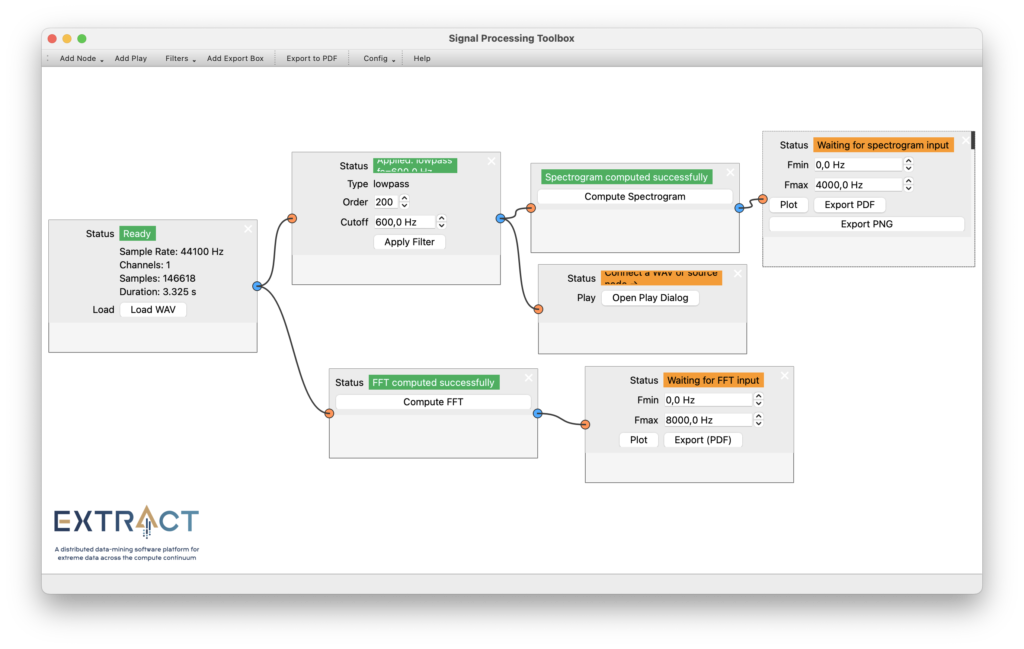
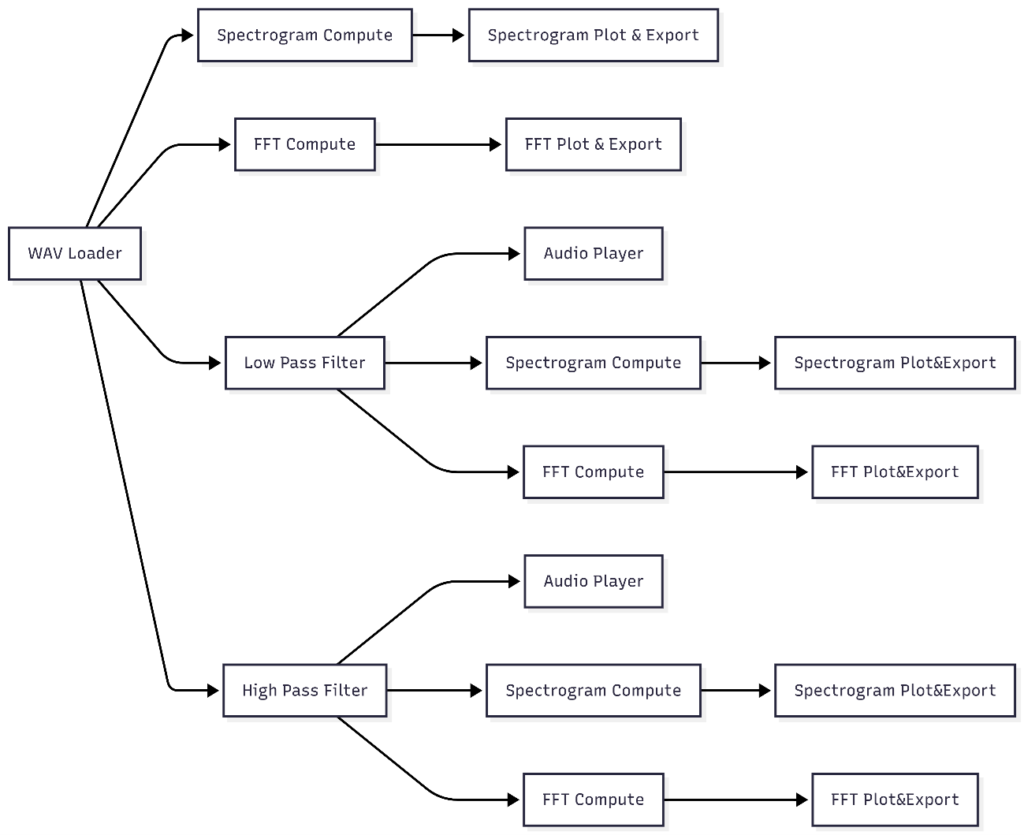
Figure 2: A diagram illustrating a sample workflow to process sound, giving the full potential of the GUI the student developed.
Impact for the Astronomy Community
This simple signal processing use case enabled the student to focus on the GUI practicality and adding new simple boxes. The interface supports a wide range of applications, from calculators and music synthesis, to signal processing/filtering, and process modeling. For the astronomy community, this kind of interface has real practical value, especially in the EXTRACT project for the TASKA use case. Telescope data-reduction workflows can be long, complex and full of technicalities for the non-expert. Instead, simple and interactive graphical interface can be proposed to create and visualize multi-step processing chains while hiding the complex workflow details behind the scenes. This tool is a prototype framework that could help users compose and explore multiple workflow possibilities, which is the case when the exact adapted recipe needed to process your astrophysical data is unknown. By providing a visual, user-friendly environment, it simplifies access to advanced computational workflows and lowers the barrier between scientific end-users and technical implementations: a researcher can prototype a pipeline, hand it off to a collaborator, or walk an audience through a workflow during a conference without requiring everyone to be familiar with the underlying code. For teaching purposes, it can serve all physics or engineering students and teachers.
Community Outreach
Together, these activities gave engineering students direct, hands-on engagement with a live European research project. Using AI-assisted coding tools, they contributed a working GUI library that any user can build on: a tangible bonus deliverable that was not part of the original project scope, but that adds genuine value to the TASKA-C use case and the broader astronomy community.