




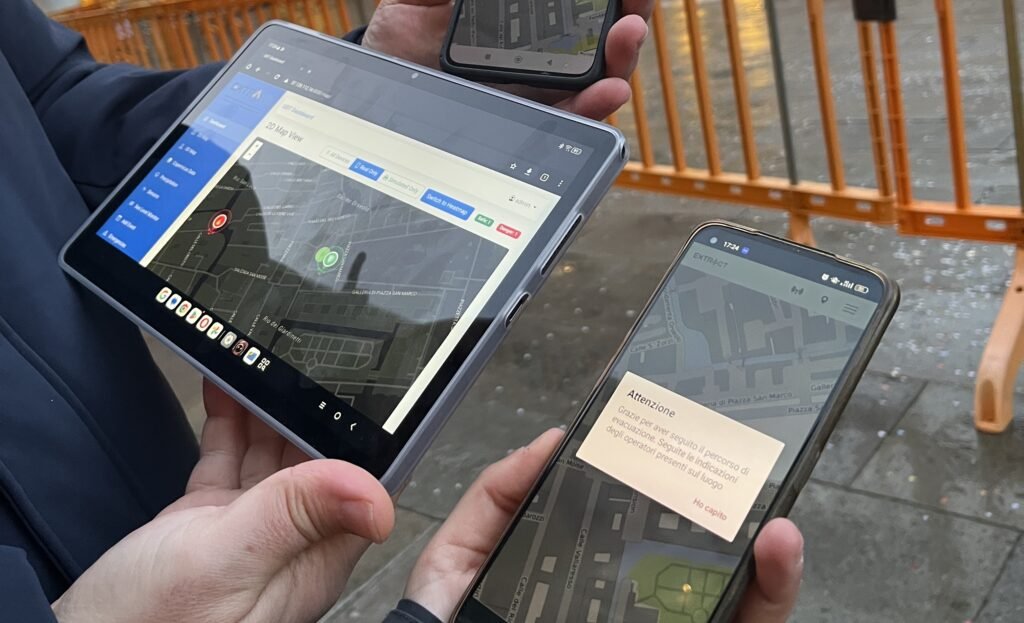
Figure 1: EXTRACT PER app and dashboard
On 04 February 2026, the EXTRACT project reached an important milestone as researchers, volunteers, and policymakers gathered in Venice to carry out the final public validation of the project technology in the Personalised Evacuation Routing (PER) System use case. The event brought together technology providers, civil protection volunteers, and city stakeholders to test the end-to-end EXTRACT system on-the-ground to show that the project’s extreme data mining workflow can work seamlessly across cloud, edge, and high-performance computing resource to guide people safely through a crisis scenario.
Extreme data mining across the compute continuum
The EXTRACT project is built around the idea that HPC, edge devices and cloud platforms can act as a single coordinated continuum. The PER validation was designed to prove this. Edge devices tracked participants’ positions using 5G connectivity, an Urban Digital Twin (UDT) running in the cloud fused this data into a live picture of the city, and an AI model, hosted on HPC infrastructure, used that information to continuously retrain and generate optimised evacuation routes. These results were delivered directly to participants’ phones, guiding them through Venice’s alleyways and streets.
Figure 2: Diagram of EXTRACT technology in PER use case
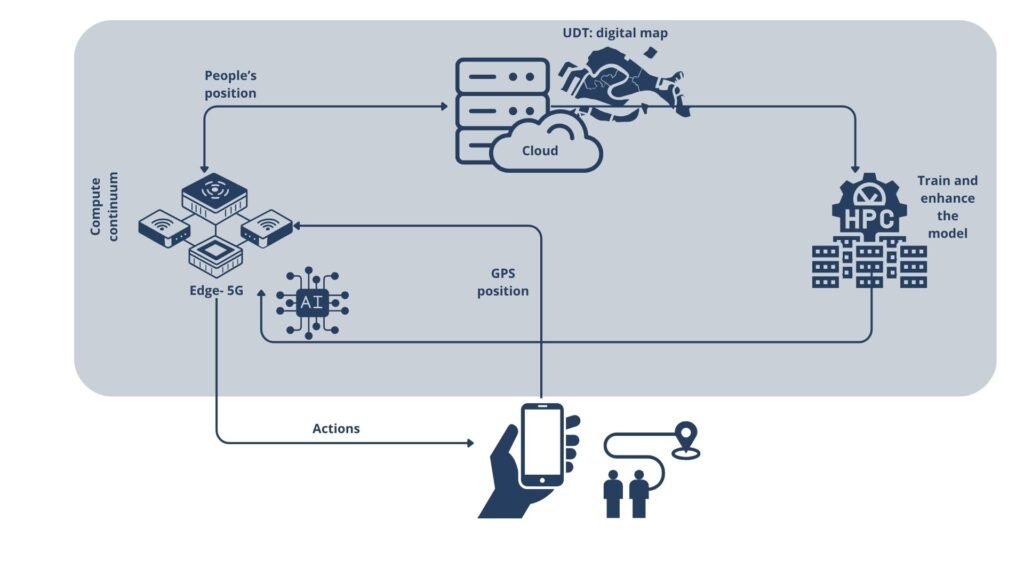
The system showed it was capable of operating as a unified whole. No single component worked in isolation, and every resource executed its role at the right time, informing the others and responding to real-time updates. IBM managed KServe, and SkyStore was successfully deployed and integrated, enabling a stable orchestration of service supporting real-time data processing. The Logos UDT integrated with the MATHEMA mobile app via a fully established socket connection, broadcasting events reliably to all connected devices, while the app sent continuous real-time location updates. BSC integrated the PER execution with COMPSs and partner tools, including the UDT, 5G-MEC, the model serving infrastructure and Nuvla.
Preparation: Closing the loop
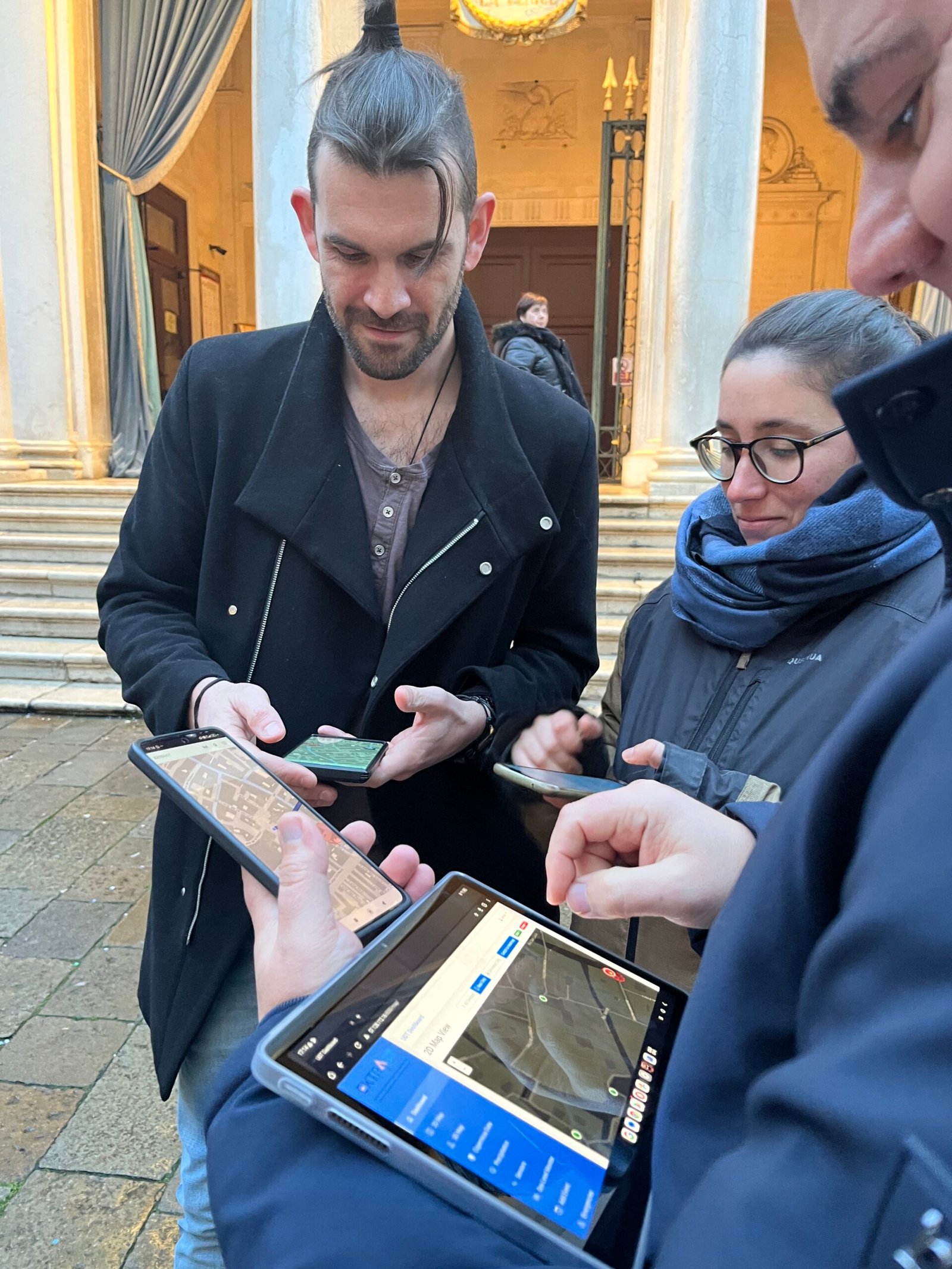
Figure 3: EXTRACT technical team testing the PER app
On 3 February, the day before the public validation, the core technology team from BSC (Alba Cañete), Logos (Ergin Mehmeti), Mathema (Simone Naldini), and IBM (Erez Hadad-remote), met to finalize technical preparation. The primary goal was to close the PER loop end-to-end: verifying that UDT data could be correctly ingested and used for reinforcement learning interference, that RL training based on UDT scenarios was functioning correctly and that routing information could reach participants’ phones through the RL interference engine while location data was simultaneously being returned to the UDT. By the end of the evening session, the team had a clear plan for the following day, including volunteer instructions and testing steps.
Validation Day
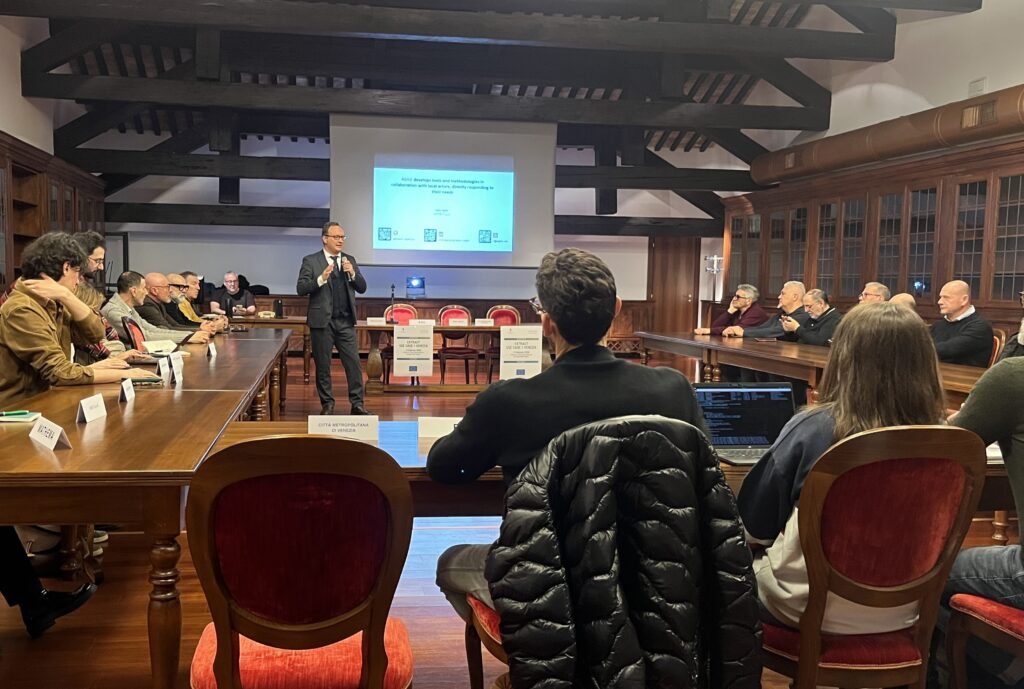
The public validation was co-organizsd with the Metropolitan City of Venice, which hosted the event. After a welcome from city representatives, and an introduction to the EXTRACT project and PER use case, a group of former civil protection officers from the city were briefed on the use of the app and the goals of the exercise.
Figure 4: Enrico Gavagnin from the Metropolitan City of Venice opens the day and explains the idea of EXTRACT (left) Simone Naldini from MATHEMA helps volunteers set up the EXTRACT PER app
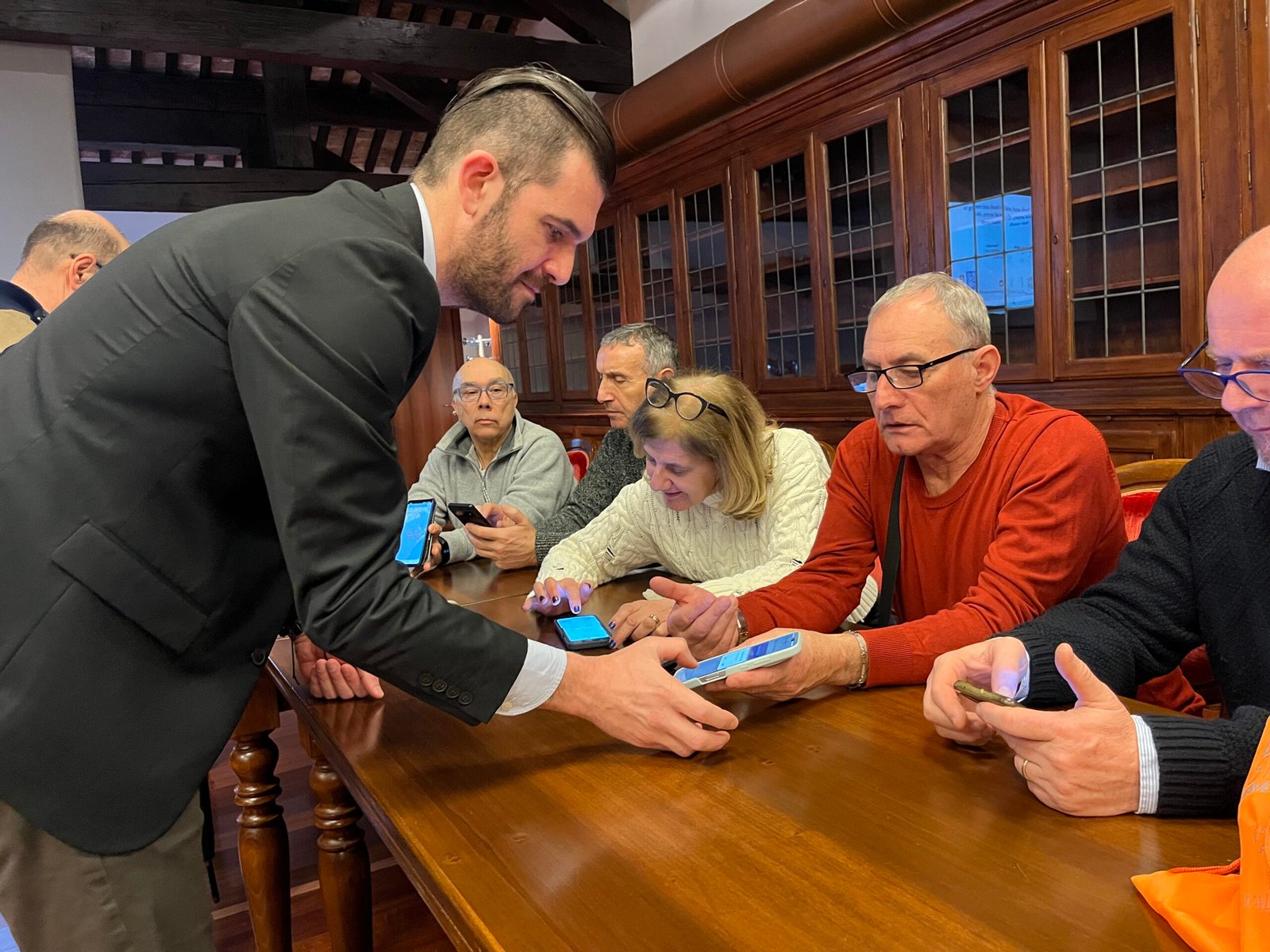
The validation began with a message on volunteer’s phones saying “Emergency in progress. Please follow the evacuation instructions” with a map showing their assigned route. Groups then set off through the streets, following routes generated by the EXTRACT PER app. Technical monitors from BSC, MATHEMA and Logos observed the process in real time, tracking participants’ positions on their screens at the event venue.
Figure 5: Two volunteers compare screens and routes during the validation exercise
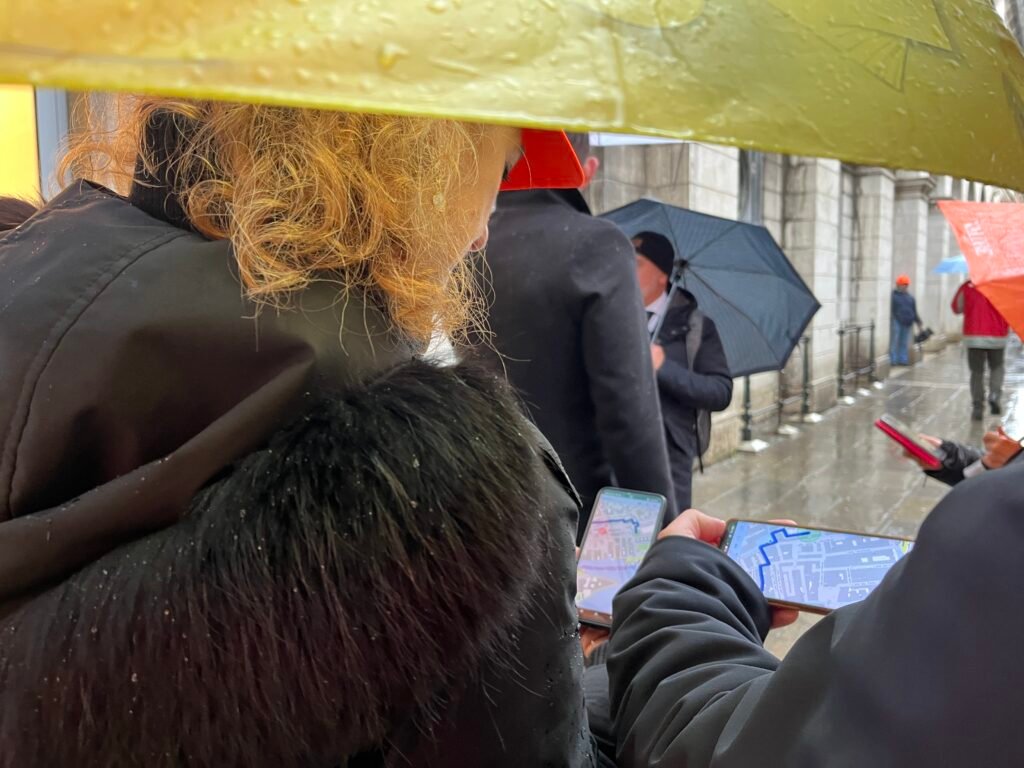
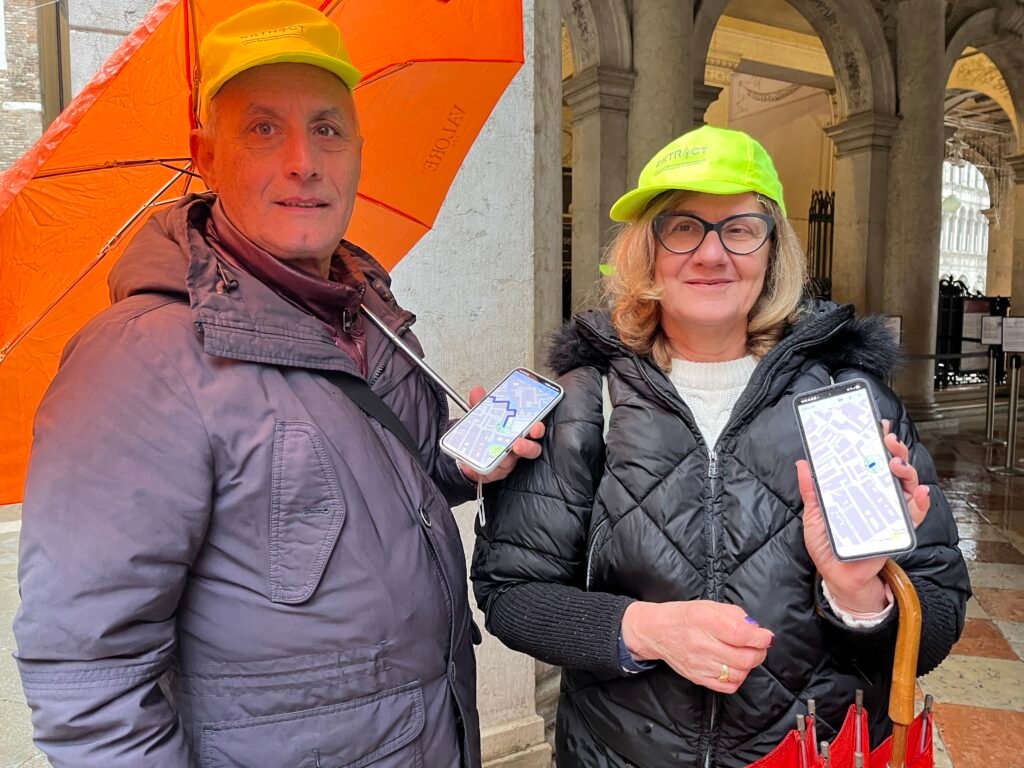
When the volunteers reached the safe spot, they received the message “Thank you for following the evacuation route. Follow the instructions of the operators on site”, followed by, “The emergency is over. The situation will return to normal soon.” The entire exercise ran for about an hour , generating a rich data set and surfacing valuable insights about system performance in a real urban environment. Issues identified during tested, including geo-positioning quality and route transmission, were noted for resolution.
Figure 6: Two volunteers showing they’ve made it to the safe zone
Why it matters
The Venice validation is the second and final evaluation of the EXTRACT PER use case and marks the culmination of three years of technical development by the project consortium. By demonstrating that HPC, edge and cloud technologies can be effectively coordinated across the compute continuum to improve data- driven decision-making in a simulated emergency, the team provided evidence that the architecture can work and be built on, thanks to its open technology.
The results will be disseminated through the deliverables and the open technology to contribute to the broader European effort to develop resilient technology-drive approach to crisis management.